
Why Swiss SMEs Need Uptime Monitoring for Data Protection and Audit Readiness
Downtime isn't just lost revenue — under the revised DSG it can become a reportable incident. Here's how uptime monitoring and public status pages keep Swiss SMEs audit-ready.
When a Swiss SME thinks about compliance, the first things that come to mind are usually the Code of Obligations (OR), MWST filings, and the correct Kontenrahmen KMU structure for bookkeeping. Few business owners think about server uptime in the same breath. Yet since the revised Swiss Data Protection Act (DSG) came into force, and in parallel with GDPR obligations for anyone serving customers in the EU, availability and incident handling have quietly become a compliance topic in their own right.
What the law actually expects
The revised DSG requires companies to take appropriate technical and organizational measures to protect personal data — and to be able to demonstrate that they did. If a customer-facing portal, invoicing system, or booking tool goes down and personal data becomes unavailable, inaccessible, or is exposed during the outage, that can qualify as a data security breach under Art. 24 DSG. The same logic applies under GDPR Art. 33 for businesses with EU customers: breaches that pose a risk to individuals need to be documented, and in many cases reported, within tight deadlines.
The common thread is not "never have downtime" — that's unrealistic for any business. The real expectation is that you can show you were watching, that you reacted promptly, and that you have a documented trail of what happened and when. For most small and medium Swiss businesses running on spreadsheets, personal phone alerts, or no monitoring at all, that paper trail simply doesn't exist.
Where manual processes create risk
Without structured monitoring, a typical SME finds out about an outage one of three ways: a customer complains, an employee stumbles across it, or nothing happens at all until someone notices invoices haven't synced in days. None of these paths produce a timestamp of detection, a record of who was notified, or a note on when the issue was resolved. If a fiduciary or auditor later asks "when did you become aware of the outage, and how did you respond," the honest answer is often "we're not sure."
This gap is particularly risky for businesses running nightly batch jobs — backups, MWST data exports, payroll syncs, CRM reconciliations. If a cron job silently fails, there is frequently no mechanism to catch it until the downstream damage is visible, by which point data may already be inconsistent or missing for a reporting period.
How uptime monitoring closes the gap
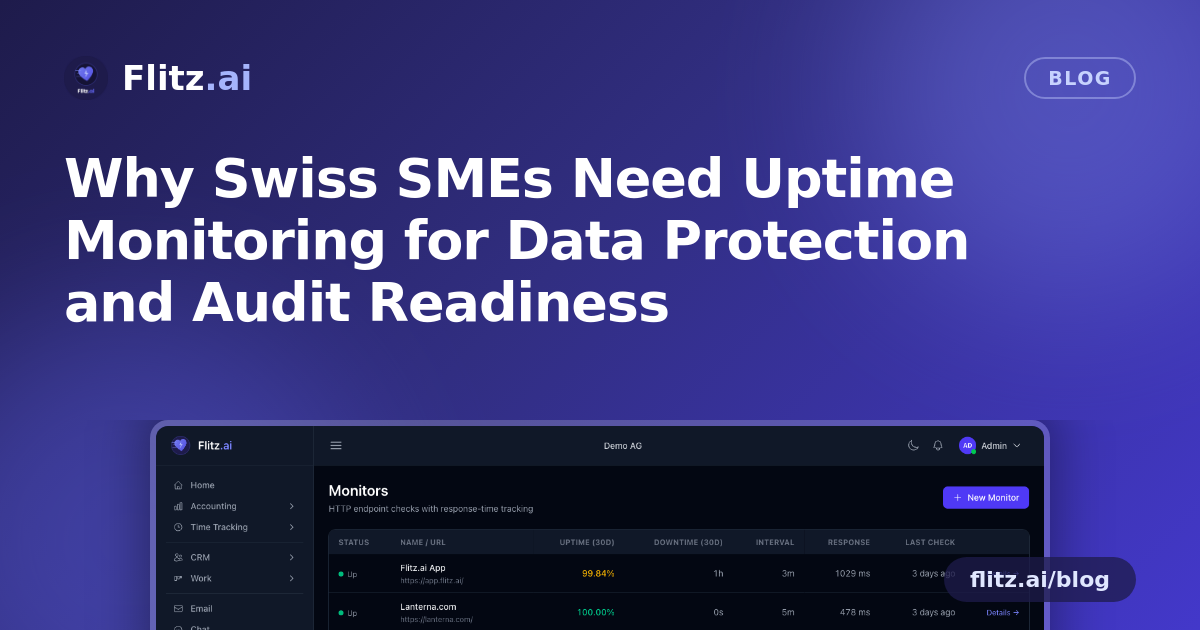
Flitz's uptime monitoring and public status pages module was built around exactly this problem: give Swiss SMEs the same infrastructure discipline that larger enterprises take for granted, without needing a dedicated IT team.
- Continuous detection. Every HTTP/HTTPS endpoint is checked every 30 seconds from EU infrastructure, so outages are caught in near real time rather than discovered by a customer.
- Cron-job heartbeats. Scheduled jobs — nightly backups, MWST exports, payroll runs — ping a private URL on completion. If the ping is late, an incident opens automatically. This is the control that manual processes almost never have: proof that a backup actually ran, not just that it was scheduled to.
- A documented incident timeline. Every incident captures acknowledge and resolve actions, threaded comments, and post-mortem notes. This is precisely the record a fiduciary, auditor, or data protection advisor will ask to see after an outage affecting personal data.
- Alerting with accountability. Email and team chat alerts fire on every status change, with on-call schedules and escalation policies so an incident is never left unacknowledged simply because the responsible person was unavailable.
- Transparency toward customers. A branded public status page on your own subdomain lets you communicate proactively during an incident — showing only the components you choose — which is far better received by clients and partners than silence followed by an apologetic email.
- SSL and certificate expiry tracking. An expired certificate is a common, entirely avoidable cause of downtime and a security weak point; monitoring catches it before it becomes an incident.
- Tenant isolation. Every monitor, heartbeat, and incident is scoped strictly to your company. There is no cross-tenant leakage of monitoring data, which matters when the monitoring system itself touches information about your infrastructure and customer-facing services.
From reactive firefighting to audit-ready documentation
The practical benefit for a Swiss SME is not just fewer surprises — it's a structured, timestamped history that turns "we think we responded quickly" into "here is exactly when we detected it, who acknowledged it, and when it was resolved." That history is useful well beyond a DSG inquiry: it supports conversations with your fiduciary about data reliability, gives your IT or operations lead a single place to track service health, and reassures customers who increasingly expect transparency from the vendors they depend on.
Consolidating this into one platform also removes the sprawl of running separate tools like Better Uptime, UptimeRobot, Pingdom, or Atlassian Statuspage alongside your core business software. For an SME already juggling accounting, invoicing, banking, CRM, and HR in one place, adding infrastructure monitoring and status communication to that same system means one less vendor relationship, one less login, and one less gap in your compliance story.
Availability isn't just an IT concern anymore — for Swiss businesses handling personal data, it's a documented part of doing business responsibly.
Setting up monitors and heartbeats takes minutes, but the audit trail it builds compounds in value every day it runs quietly in the background.